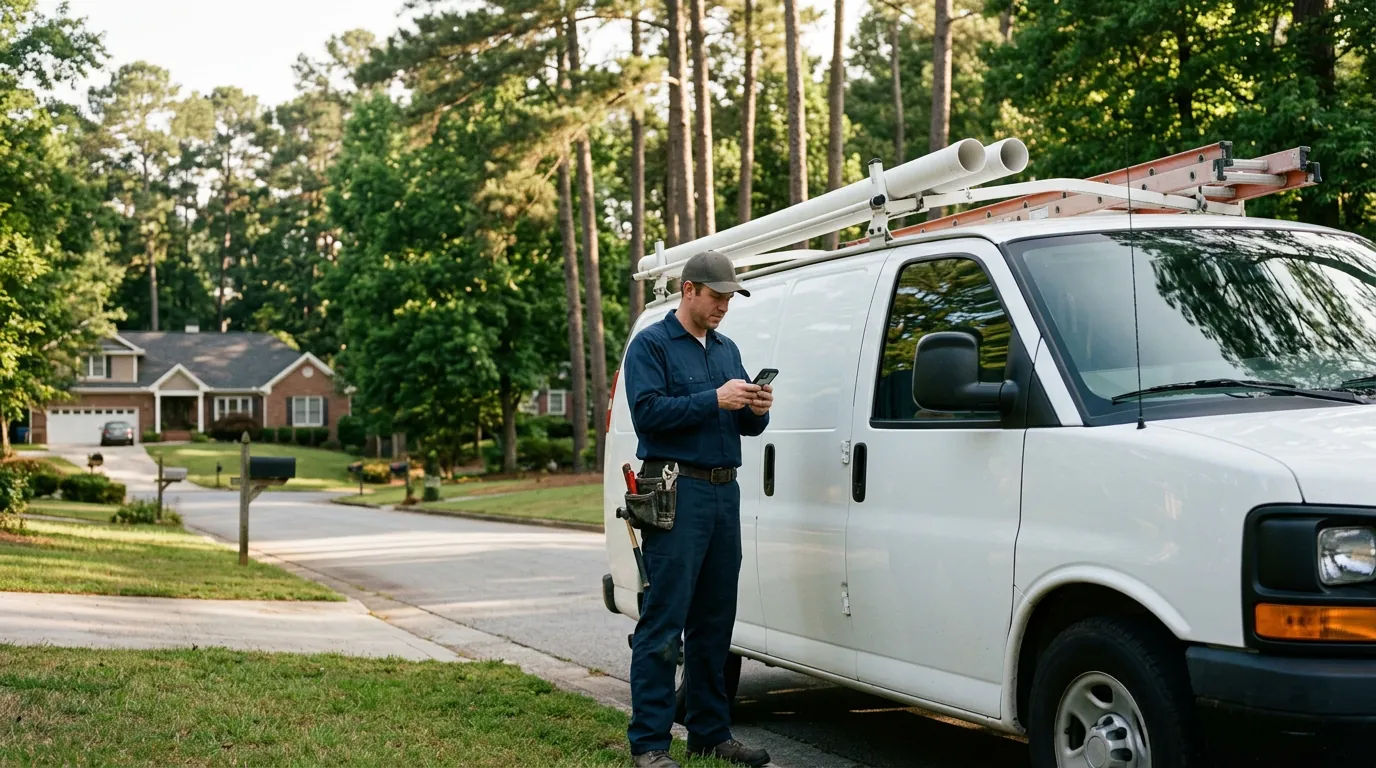
No storefront? Here is how plumbers, roofers, and other service area businesses can rank in Google Maps and AI answers across Atlanta and its suburbs.
A roofer based in Kennesaw lands jobs in Marietta, Acworth, and Smyrna every week. Yet when a homeowner in Smyrna searches for a roofer, the map results show three companies with shop addresses nearby and nothing from Kennesaw. That gap is the everyday problem of service area business SEO. If you drive to your customers instead of having them come to you, Google still ties your map visibility to one verified location, and the rest of the metro has to be won another way.
It matters more in Atlanta than in most markets. The metro sprawls across many counties, traffic makes “nearby” a relative idea, and a homeowner in Alpharetta or Decatur who needs a plumber or a pest control company usually picks from whoever shows up first, on the map or in an AI answer.
This guide covers how Google treats businesses without a storefront, how to set up your Business Profile within the rules, how to build suburb pages that rank instead of getting ignored, and how to tell whether any of it is working.
What counts as a service area business
A service area business travels to customers or delivers to them rather than serving them at its own address. Google sorts local businesses into three types, and which one you are changes how your profile should be set up.
- Service area business: you visit or deliver to customers and don’t serve them at your address. Plumbers, HVAC techs, house cleaners, mobile detailers, and landscapers fit here.
- Hybrid business: you serve customers at your location and also go to them, like an auto repair shop that offers roadside service.
- Storefront business: customers come to you, like a dental office in Sandy Springs or a restaurant in Decatur.
Most home service companies across metro Atlanta are pure service area businesses, often run from a home office or a small warehouse. That is completely legitimate, but it changes the rules you play by.
How Google ranks a service area business
Google ranks local results mainly on relevance, distance, and prominence, and for a service area business the distance part is still measured from the address you verified, even though customers never see it.
Google says this plainly in its explanation of how local results are ranked. Relevance is how well your profile matches the search. Distance is how far you are from the person searching. Prominence is how well known and well reviewed your business is.
The part that surprises owners is that adding cities to your service area does not move your pin. Listing Roswell, Johns Creek, and Duluth tells customers where you work, but in our experience it does not make you rank in those cities the way a nearby storefront does. Map visibility is usually strongest close to your verified location and fades as searchers get farther away.
So the strategy has two parts. First, own the map near your base by doing the profile work well. Second, win the wider metro through organic results, suburb pages, reviews, and authority, which are not tied to your pin in the same way.
“Your service area tells customers where you work. It does not tell Google to rank you everywhere you listed.
Set up your Google Business Profile within the rules
Hide your address if customers don’t visit you, list the areas you really serve, and stay inside Google’s guidelines. A suspended profile is far harder to fix than a weak one.
Google’s guidelines for representing your business are specific about service area businesses. The essentials:
- If you don’t serve customers at your address, hide it and show only your service area.
- You get one profile for your central office. Extra profiles are only allowed for separate locations with their own staff and service areas.
- Virtual offices don’t qualify unless they are staffed during your business hours.
- You can list up to 20 service areas, and the overall area shouldn’t stretch much beyond about two hours of driving from your base.
Inside those rules, choose the most accurate primary category, add every service you actually perform, write a description that names the kinds of jobs you take, and post real job photos regularly. Our Google Business Profile management work for Atlanta trades usually starts with exactly this kind of cleanup, because many ranking problems trace back to the wrong category or a guideline issue nobody noticed. For the rest of the fundamentals, work through our Atlanta local SEO checklist.
A word on borrowed and virtual addresses
It is tempting to rent a mailbox in Buckhead or Alpharetta to get a pin closer to the customers you want. Don’t. It breaks the guidelines, competitors do report it, and a suspension can pull your profile off the map entirely while you sort it out.
Build service area pages that earn rankings
A service area page ranks when it is genuinely useful to someone in that suburb. Swapping the city name into the same template produces thin doorway pages that Google discounts and customers ignore.
Because your map reach is limited by distance, organic pages do most of the work in suburbs away from your base. A homeowner in Johns Creek searching for water heater replacement will usually see the map pack and then organic results, and a strong local page can win that organic spot even if your shop is in Marietta. This is where service area business SEO earns its keep.
What a strong suburb page includes
- Real jobs completed in that area, with photos and a short note on the problem and the fix
- Local details that affect the work, such as older housing stock in Decatur, HOA rules common in Alpharetta subdivisions, or which city or county handles permits
- Reviews from customers in that suburb, quoted with their permission
- Clear service details, typical response times to that area, and price ranges if you share them
- A short FAQ answering questions people in that town actually ask you
Start with the five or six suburbs that bring you the most profitable work, not all 20. A handful of excellent pages beats dozens of thin ones, and you can add more as you collect jobs and reviews in each area. If you work in the trades, our page on SEO for Atlanta contractors shows how this fits into a broader plan.
Storefront vs. hybrid vs. service area: what changes
The type of business you are changes where your rankings come from and which tactics matter most.
| Storefront | Hybrid | Service area business | |
|---|---|---|---|
| Address shown on Google | Yes | Yes | No, hidden |
| Service areas listed | No | Yes | Yes, up to 20 |
| Map visibility is strongest | Around the storefront | Around the storefront | Around the verified, hidden address |
| Main way to reach far suburbs | Organic pages and reviews | Organic pages and reviews | Suburb pages, reviews, and local authority |
| Biggest risk | Inconsistent listings | Claiming an unstaffed location | Borrowed addresses and duplicate profiles |
Earn local proof in every suburb you serve
Prominence travels further than your pin does. Reviews, mentions, and links tied to specific suburbs are how a service area business builds visibility across the metro.
- Ask for a review after every job. Customers often mention the service and their town on their own, so never script or reward the wording.
- Keep your business name and phone number identical across directories, trade associations, and supplier listings.
- Show up in the suburbs you want: sponsor a youth team in Kennesaw, a neighborhood festival in Decatur, or join a local chamber of commerce.
- Earn mentions from local news, HOA newsletters, and community sites. These are hard for competitors to copy.
None of this is fast, but it compounds. A steady stream of reviews and local mentions over a year or two is what lets a Kennesaw company start showing up for searches in Smyrna. Our local SEO services are built around that kind of steady progress rather than quick tricks.
Make sure AI answer engines know where you work
ChatGPT, Perplexity, and Google’s AI Overviews describe service businesses based on what they can read about you, so your service area needs to be stated clearly on your own site and repeated consistently across the web.
When someone asks an AI assistant for a reliable HVAC company that serves Roswell, the answer is assembled from sources the model can parse. If your site never says plainly that you serve Roswell, and no review or directory mentions it either, you are an unlikely pick. Hiding your address on Google makes this more important, not less, because there is no storefront location for the model to fall back on.
- State your service area in plain text on your homepage and contact page, not only inside an image map
- Add LocalBusiness structured data with an areaServed property listing the cities you cover
- Keep that list consistent between your site, your Business Profile, and major directories
- Make sure your site lets AI crawlers in so they can actually read it
This is a core part of our generative engine optimization work for local businesses, and our primer on what GEO means for Atlanta businesses covers the basics. The same clarity also helps Google match your suburb pages to the right searches.
Track visibility suburb by suburb
Track rankings from many points across your service area. A single rank check from your office tells you almost nothing about how you look to a customer 25 miles away.
Grid-based map tracking checks your position at dozens of points across a map, so you can see where you rank well and where you drop off. For a service area business, that picture is the whole story: strong around the base, then a falloff that shows which suburbs need pages, reviews, or links. Pair it with Search Console data by page and with calls tagged by city, so you know which areas actually bring in revenue.
Frequently asked questions
Does adding more service areas help my Google Maps ranking?
Not directly. Service areas tell customers where you work, but map rankings still lean heavily on distance from your verified address. Use service areas to describe your real coverage, and use suburb pages, reviews, and local authority to reach farther out.
Should a service area business hide its address on Google?
Yes, if customers don’t come to your location. Google’s guidelines say businesses that don’t serve customers at their address should hide it and show only a service area. Hybrid businesses that do receive customers can show both.
How many service area pages should I create?
Start with the suburbs that bring you the most profitable work, often five or six, and make each one genuinely useful with local jobs, photos, and reviews. Add more as you build real proof in new areas rather than publishing a page for every city at once.
Can I open a second Google Business Profile for another part of Atlanta?
Only if it is a real location with its own staff and service area. A mailbox, virtual office, or unstaffed address does not qualify and puts your profiles at risk of suspension.
How long does service area business SEO take to show results?
Profile fixes can show movement within weeks, but ranking in suburbs away from your base usually takes several months of consistent reviews, content, and links. Be wary of anyone who guarantees map rankings across the whole metro.
Service area business SEO: key takeaways for Atlanta
- Your map visibility is anchored to your verified address, even when it is hidden.
- Follow Google’s service area rules exactly. A suspension costs more than any shortcut gains.
- Win distant suburbs with useful local pages, reviews from real customers there, and local authority.
- Spell out your service area on your site so AI answer engines describe you correctly.
- Measure visibility across a grid, not from your office.
If you want a second set of eyes on how your business shows up across the suburbs you serve, we are happy to run a free local visibility audit and walk you through what we find. No pressure, just a clear picture of where you stand today.
Atlanta local SEO and generative engine optimization specialists helping local businesses win Google Maps, organic search, and AI answer engines.

